ART GENÈVE: ART GENÈVE | GENEVA, SWITZERLAND
Overview

BOOTH D32 and D32S
AFIKARIS is pleased to present a monographic exhibition dedicated to Moroccan artist Mouhcine Rahaoui (born 1990). His work composes an aesthetic of the miner and shapes its legend. Landscapes emerge from matter as if dissecting the entrails of the earth, excavating horizons that are both mysterious and unsettling.
Mouhcine Rahaoui’s abstraction conveys the atmosphere of the city of Jerada, haunted by the mine and by those who worked there—and who, despite the legal end of its exploitation in the early 2000s, continue to do so. The artist develops his visual vocabulary from the miner’s lexicon, intimately binding the worker to his environment and inseparably intertwining their destinies, much like wax merging with coal. The miner is reincarnated in the object itself, caught up once again in the reality of his condition.
On the second booth, works by Saïdou Dicko (born 1979, Burkina Faso), Nasreddine Bennacer (born 1967, Algeria), Ozioma Onuzulike (born 1972, Nigeria), and Hervé Yamguen (born 1971, Cameroon) are brought together in a sensitive dialogue between shadow, ornament, and nature. Each work weaves a poetic and sensory narrative.
Since childhood, shadow has been central to Saïdou Dicko’s practice. As a young shepherd, he traced the contours of his surroundings—trees, animals, landscapes—through their shadows. Later, he chose to depict human figures as black silhouettes, anonymous and universal. Around these forms, he integrates ornaments inspired by traditional textiles, often composed of floral and vegetal motifs.
While in Saïdou Dicko’s work shadow becomes a figure of universality and rootedness, in Nasreddine Bennacer’s practice it transforms into a fragile veil. Drawing inspiration from Mesopotamian vestiges found in the valleys of the Tigris and Euphrates, Bennacer invents his own vision of the Hanging Gardens of Babylon—mythical masterpieces of Antiquity whose archaeological existence remains uncertain. This uncertainty, far from being a lack, becomes the driving force of the work. Through chiaroscuro, the artist sketches architectural elements that are incomplete, fragile, almost abandoned, gradually overtaken by vegetation, as if human creation were already yielding to the power of time and nature.
From these fleeting, almost tactile forms emerges the materiality of Ozioma Onuzulike’s works. Clay, an earthly element, replaces paper and becomes, in turn, the bearer of a collective memory shaped by gesture and tradition. In Onuzulike’s practice, earth—and more precisely clay—becomes language. Modeled into thousands of fragments, it forms sculptures evoking traditional garments, poised between form and ornament. These works engage with light, shimmer, and cast shifting shadows, recounting—without words—the history of artisanal gestures, transmitted traditions, and what remains embedded within matter itself.
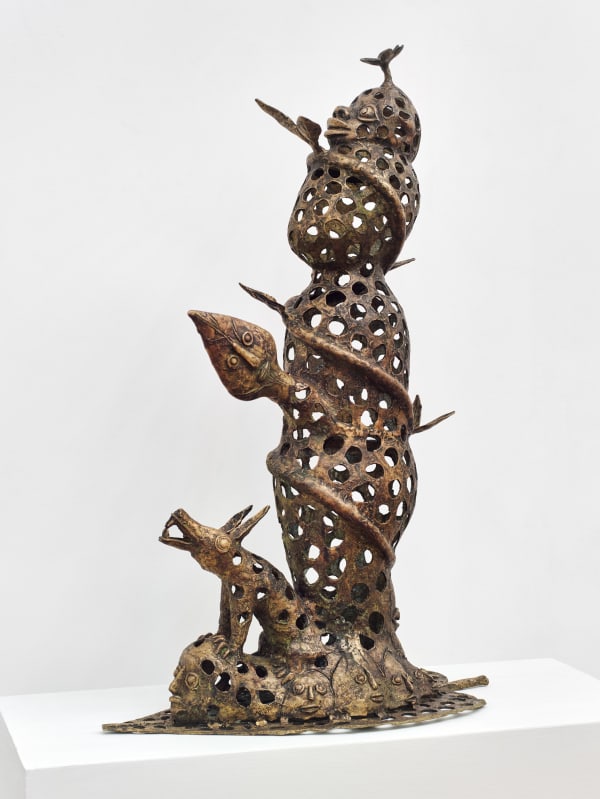
Finally, Hervé Yamguen carries material into the realm of the living and of metamorphosis. His bronze sculptures reveal hybrid forms, at the crossroads of human, animal, and vegetal. They embody a vision of life in which boundaries dissolve. Inspired by a poetic and animist way of thinking, his works evoke transformation and the invisible connections between beings and things. Within the stand, they appear as spirits of an imaginary forest, around which stories of shadow, memory, and transformation are woven.
--
AFIKARIS Gallery
Booth D32 and D32S
Palexpo, Geneva, Switzerland
DATES AND TIMES
VIP PREVIEW
2 PM – 9 PM | Wednesday, 28 January
PUBLIC OPENING HOURS
12 PM – 7 PM | Thursday, 29 January
12 PM – 8 PM | Friday, 30 January
12 PM – 8 PM | Saturday, 1 February
EXHIBITING ARTISTS
Nasreddine Bennacer
Saïdou Dicko
Ozioma Onuzulike
Mouhcine Rahaoui
Hervé Yamguen
Works